Page Title: 19th Amendment Suffragist Flags
|
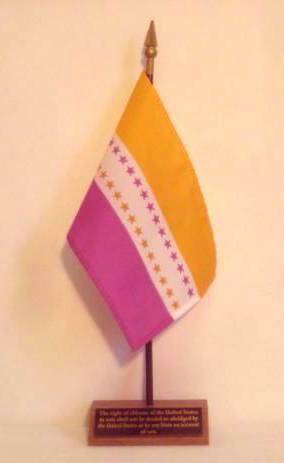
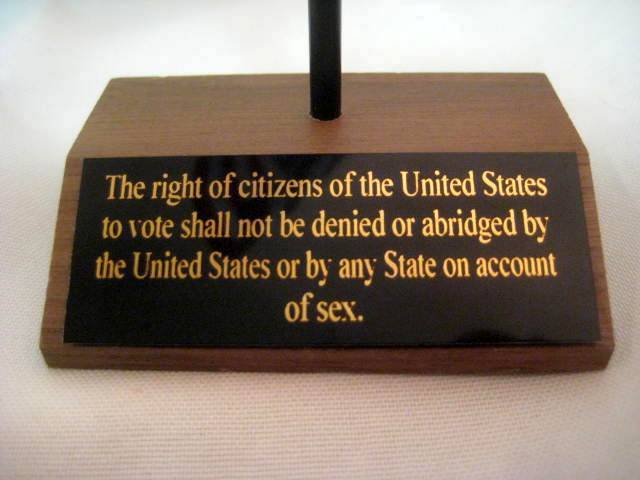
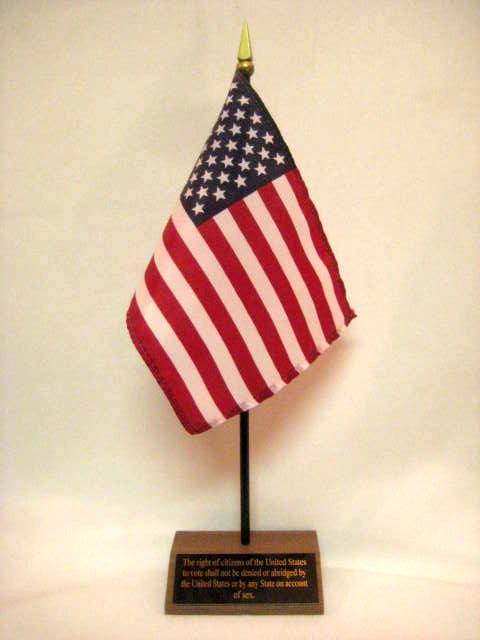
#WN1S $ 19th Amendment Desk Flag 4x6" flag on 10" staff with walnut base and an engraved plate with the text of the 19th amendment
|
|
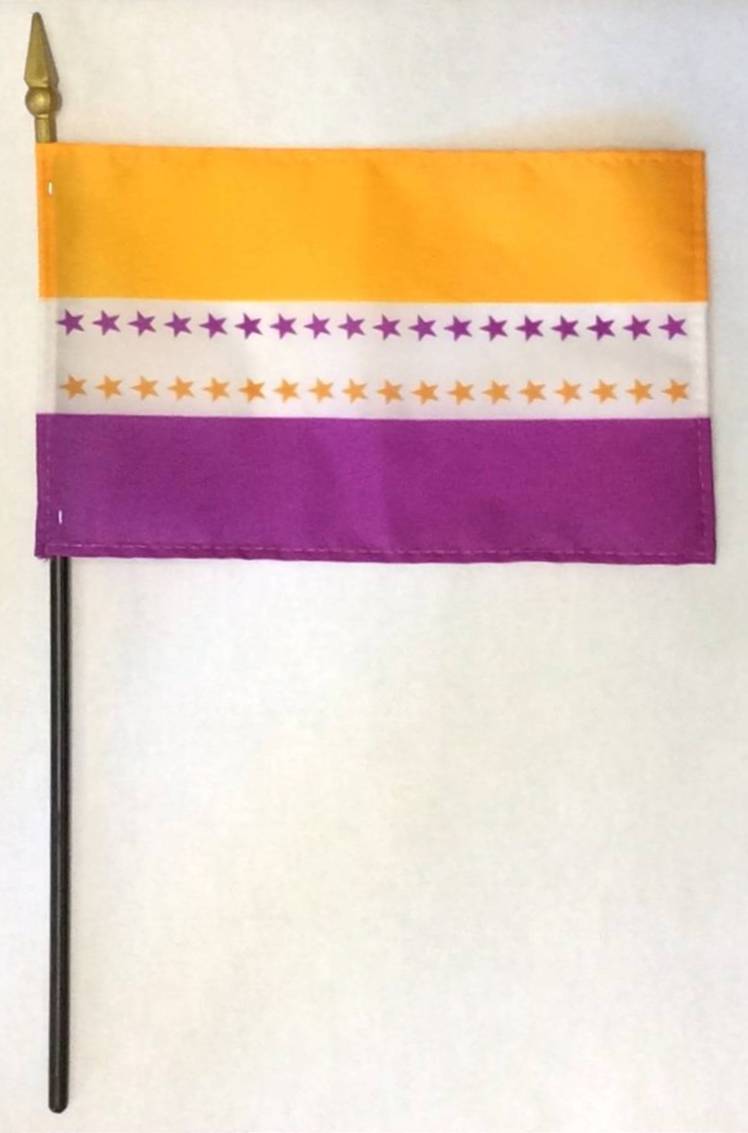 |
19th Amendment Victory Flag 4x6" on a 3/16" x 10# Spear Tip flag #UNI438 CLOSEOUT: $2.95 each; $2.25 each for three or more CAUTION: SPEAR TIP. USE UNDER ADULT SUPERVISION |
|
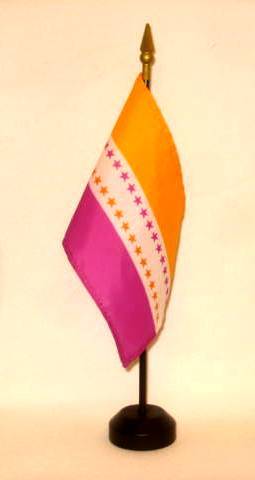
#WN1SE 19th Amendment Desk Flag 4x6" flag on 10" staff with base $7.30 Each $5.50 for each 12 or more
|
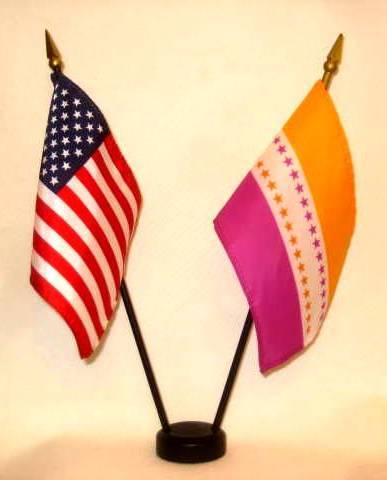
#WN2SE Two 4x6" flags on 10" staff with base $7.60 Each $8.60 for each 12 or more
|
|
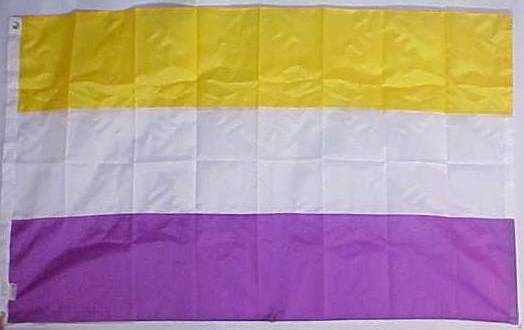
Suffragist Flag: Flag of the National Woman's Party. They were American women who wanted to vote. In silent non-violent protest they stood in front of The White House holding flags and banners which quoted President Wilson's own speeches about democracy. They remained there in shifts for months regardless of weather. But no one had ever picketed The White House. Their action was viewed as unpatriotic in some circles. Then, US entry into WWI increased the mob violence against them. It was war time and they were accused of "being against The President". They were labeled "unpatriotic." Children spit on them. Men assaulted them. The police stood by and watched. The government arrested the women themselves, rather than their attackers, for "obstructing traffic."
Demonstrations spread to other cities. The women were
beaten by police in Boston. In New York, they were "attacked by police, soldiers
and onlookers."
Hundreds of women were arrested for "obstructing traffic." In
defense of their civil liberties, many who could have avoided prison by paying
fines refused to so. Their position was that they had not broken any law and
that their arrests were politically motivated. The Wilson administration refused
to yield and its tolerance dwindled.
All they wanted to do was vote. With the escalating political climate, earlier government leniency gave way to harsher sentences and treatment. Prison "became more closely synonymous with compromised health and bodily harm." Conditions included primitive sanitation, meager food full of insects and worms, isolation, psychological duress. Their protests continued in jail with hunger strikes and refusal do their work assignments. "The Night of Terror" November 15, 1917 in Occoquan Work House seems to have been a calculated attempt to end the picketing. Women were beaten, knocked unconscious and handcuffed with their arms above the head. The government tried to get their leader, Alice Paul, declared insane.
|
#WN119 $ American Desk Flag with text of the 19th Amendment
This was their flag. Remember it the next time you don't vote. #H116 $34.00 National Woman's Party Flag 3x5' Rugged outdoor nylon, heading and grommets. Sewn stripes, NOT printed MADE IN USA Note on the words suffragette and suffragist What is the difference between a suffragette flag and a suffragist flag? On the tour at the Library of Congress current exhibition "Shall Not Be Denied, Women Fight for the vote" (through September 2020), the guide said that the suffix "ette" was a diminutive added in England and meant to disparage women advocating for voting rights. The National Park Service agrees. Its web site states that suffrage means having the right to vote and a suffragist is one who advocates for that right. After a British reporter coined the word suffragette as a derogatory term meaning "little suffragist", women began using it themselves thus claiming the word as a label of pride. In the United States, the term suffragette was not embraced by the suffrage movement but remained a derogatory term used by anti-suffrage opponents. Many of these opponents were women themselves who formed their own organizations opposed to women being allowed to vote. |
|
All they wanted to do was vote. On March 4, 1918 A US Federal Appeals court declared unconstitutional the detainment of all White House suffrage pickets. No one was prosecuted or even in trouble for their unlawful arrests and imprisonment. And arrests would still go on elsewhere. In the end, they won. President Wilson changed his position to support women's suffrage. By the time it was achieved with the 19th amendment in 1920, 168 NWP members had served time. My information and the direct quotes are taken from The Library of Congress web site |
|
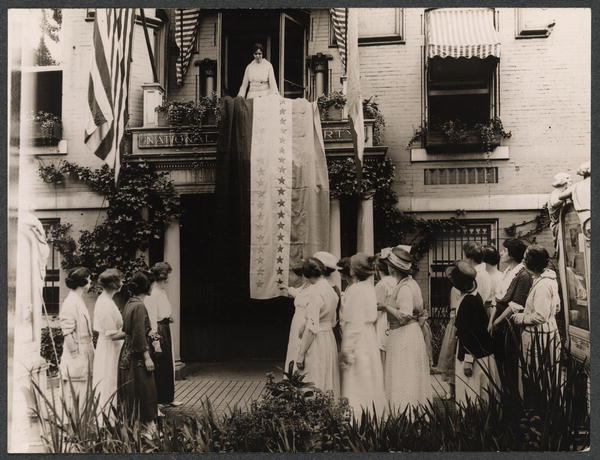
This is the flag they used to celebrate their victory.
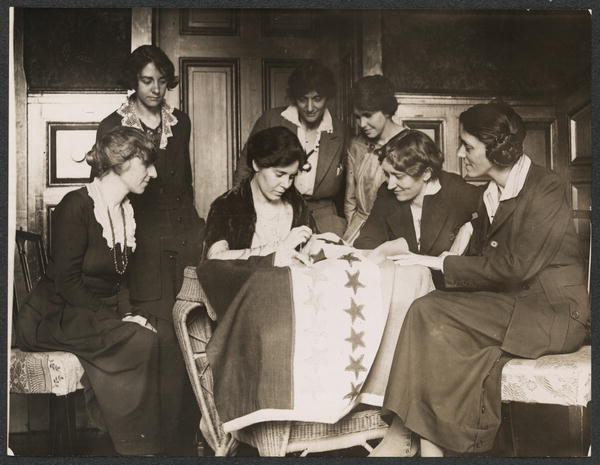
Alice Paul sews a star on to a "ratification banner" (from Library of Congress Collection) You see, as the 19th amendment made its way through the approval process, the ladies sewed a star on their flag each time another state ratified it. They needed 36.
Many states had defeated the amendment. It came down to the great State of
Tennessee, a lady named Febb Ensminger Burn On August 18, 1920 the legislature was deadlocked and so the measure would fail. Then in a moment of high drama, 24 year old Harry Burn suddenly changed his vote in a role call. That morning he had received a letter, still in his pocket, from his mother in which she urged him "Don't forget to be a good boy" and to "vote for suffrage." |
The Alice Paul Flag
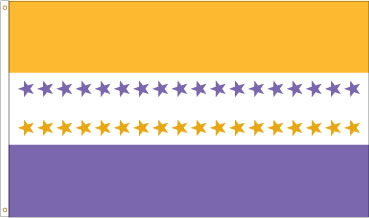
#H140P $24.95 19th Amendment Victory Flag 3x5' outdoor polyester heading and grommets, printed stars and stripes
|
|
He did. Pandemonium resulted. Women were screaming, weeping. Burn was
chased from the room and had to hide in the attic. The next day he took the floor and gave reasons for
having changed his vote. Among other reasons he stated "I know that a
mother's advice is always safest for her boy to follow, and my mother
wanted me to vote for ratification." Upon the news that the struggle was
over, Alice Paul unfurled this now completed flag from the balcony at
National Woman's Party headquarters in Washington DC.
"When Tennessee the 36th state ratified, Aug 18, 1920, Alice Paul, National Chairman of the Woman's Party, unfurled the ratification banner from Suffrage headquarters" From the Library of Congress web site The organized struggle, begun 1848 in Seneca Falls, NY, had ended in Nashville, TN. It had taken the combined efforts of millions of women. Their ultimate willingness to be arrested and abused had finally shocked the nation into supporting their cause. Those who had begun the struggle did not live to see the victory. Those who completed the struggle were not born when it had begun. Where would we be without people among us who are willing to change the world? This was their flag. Remember it the next time you don't vote! |
|
|
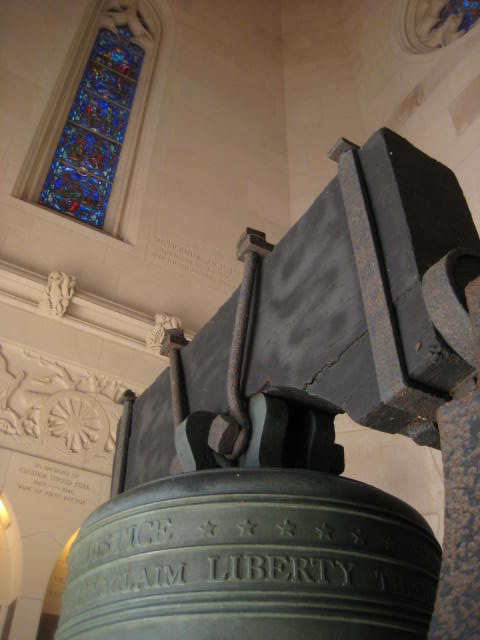
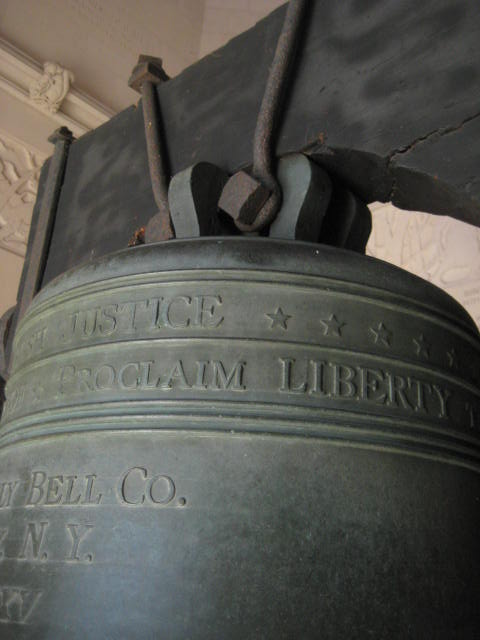
Cool Links Related to this topic The Justice Bell was a response from the women's suffrage movement to the promise made to all of us by The Liberty Bell. Katharine Wentworth Ruschenberger of Pennsylvania paid for the bell which was cast by Meneely Bell Co in Troy, NY. In June of 1915, the same year The Liberty Bell was making its last and biggest tour out to the west coast and back, the ladies began a road trip of their own. They hauled their Justice Bell 5,000 miles all over Pennsylvania to promote an amendment to that state's constitution giving women the right to vote. The clapper of their bell was to remain chained, locked in position, rendering the bell silent until women received the liberty promised to us all. After the Pennsylvania amendment failed, The Justice Bell was used to promote the cause at events in Chicago and Washington DC. The 19th Amendment was proposed on June 5, 1919 and ratified on August 26, 1920. The following month, a celebration was held in Independence Square and following a speech by the Governor, the clapper was unchained to "ring in justice." The women who began their fight for justice did not live to see it won. The women who completed the task had not been born when it began. In the end, they all prevailed. Today The Justice Bell can be visited at Washington Memorial Chapel within Valley Forge National Historic Park.
Hear the Justice Bell Hear The Justice Bell being gently hand tapped |
|