|
 Flag
Supplies Flag
Supplies
Click the links above for help on stringing a flagpole and to
replace flagpole rope |

USA Desk Flag Liquidation |
|
The Flag GuyTM
recommends He-Man HalyardTM
MADE in USA
Increase the strength in your flagpole with
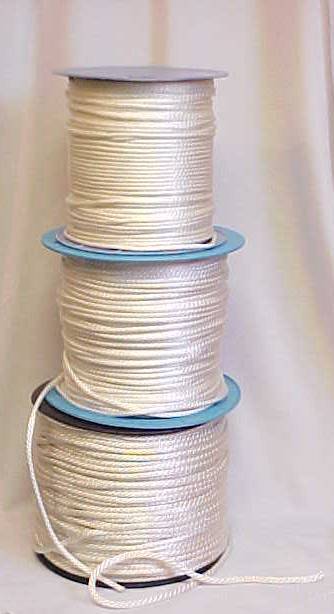
DOUBLE BRAID high performance polyester flagpole rope. Same great resistance to moisture, sunlight
UV, and abrasion that you expect in a polyester fiber. Great
resistance to rot and mildew. This is a a critical component of your
flagpole supplies. This is our first choice when re-roping a flagpole.
Double braid construction consists of a
tightly-braided jacket over a braided core is like a rope within
a rope. Double braid construction gives you about TWICE the breaking
strength of standard solid braid polyester halyard. This product
is clearly for someone who wants to get the best
available double braid polyester halyard.
Halyard, flag rope, is NOT returnable.
SCROLL DOWN TO SEE
BROWN HE-MAN HALYARD
|
|
Double Braid Polyester
He-Man HalyardTM
Model # |
Thickness/Breaking
Strength He-Man Halyard is twice the
strength of solid braid polyester halyard |
Price per
foot We'll cut you as many feet as you want. |
Price per
600' Foot Spool |
|
#8HM |
1/4" 1,935 lbs |
64 cents per foot |
$266 |
|
#10HM |
5/16" 2,975 lbs |
90 cents per foot |
$316 |
|
#12HM |
3/8" 4,275 lbs |
$1.10 per foot |
$391 |
|
#16HM*
too thick to fit most trucks and pulleys |
1/2" 7,425 lbs* |
$1.74 per foot; Less than full spool
lengths of this size are limited to stock on hand. When it is gone
it will be available only in full spools |
$563 |
|
*Breaking strength is given
only for comparison and for those who like information. It is NOT an
indication that you should be standing under a piano weighing 2,974
lbs held by our #10HM halyard. We sell rope only for use in
flagpoles. Our halyard is NOT sold for use as safety lines. It is
NOT sold for use in raising or pulling loads or people.
Safety
Warning
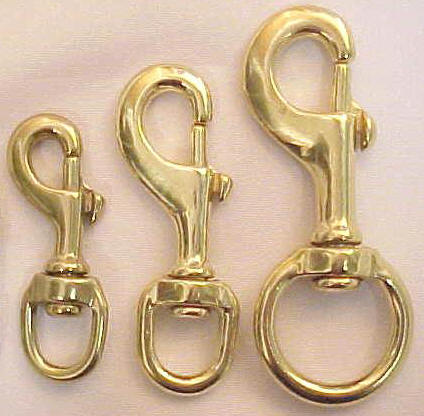
Snap Hooks
*Be careful about size.
Size# 16 1/2" is so thick it will fit only ONE of our trucks: #HDT2 Shown on our trucks page. This
size is NOT commonly used in the flag industry. It will likely NOT
fit your pulley or truck. I offer it for folks using our HDT2 truck
who want the thickest rope they can get. I also offer it for those
who have built their own giant custom trucks that will take oversize
halyard.
Check your size! Most flagpoles use
1/4" or 5/16" rope. 3/8" rope or 1/2" flag rope are less common. The flag
rope needs to fit through the pulley at the top of your flagpole.
Measure the rope thickness you currently have. |
| Now Available Brown Halyard Line:
 Click to Enlarge
 |
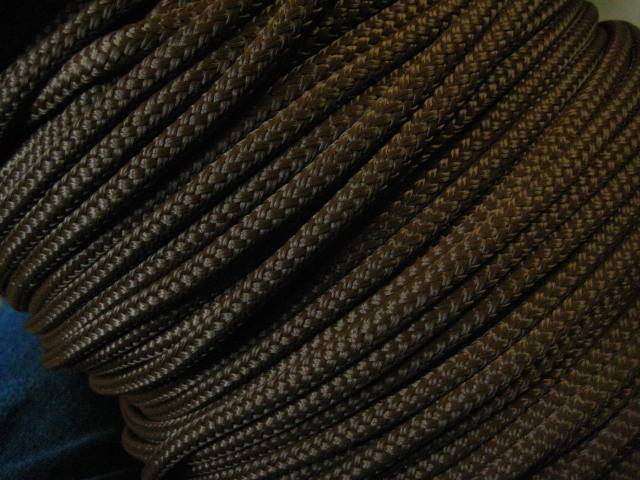
Brown Rope now available
Double Braided Polyester Brown He-Man Halyard
| Item # |
Price per foot |
Price per 600'
Foot Spool |
|
#8HMBZ 1/4" |
64 cents per foot |
$266.00 |
|
#10HMBZ 5/16" |
90 cents per foot |
$316.00 |
|
#12HMBZ 3/8" |
$1.10 per foot |
$391.00 |
Snap Hooks
|
Wire Core Flagpole Halyard Line |
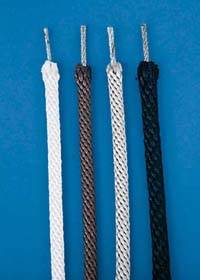
Flagpole Wire Rope with galvanized inner wire,
polyester
outer rope |
Polyester wire
core halyard line
Breaking strength for all three wire core halyards
thicknesses is only as strong as the wire inside which is 900 lbs. (compare to
the He ManTM halyard above)
Wire core rope is NOT returnable.
Wire core flagpole halyard is cut to order.
I personally prefer non-wire core halyard. I find it
much easier to work with. Some flagpole systems do call for it and
some people just prefer it. Wire core flagpole rope is more
difficult to work with.
CAUTION
Compare the strength to the He Man HalyardTM
at the top of this page.
Wire core halyard is NOT stronger than the double
braid polyester He Man HalyardTM
shown AT THE TOP OF THIS PAGE
We sell wire core because sometimes people are just
plain told to get it and some flagpoles may require it. |
| Model # |
Size |
White |
Bronze |
Silver |
Black |
|
WCH8 |
1/4" |
$0.89 per
ft |
$0.93 per
ft |
$0.94 per ft |
$0.95per
ft |
|
WCH10 |
5/16" |
$1.10 per
ft |
$1.16 per
ft |
$01.17 per ft |
$01.19 per
ft |
|
WCH12 |
3/8" |
$1.47 per
ft |
$1.55 per
ft |
$1.56 per ft |
$1.57 per
ft |
Wire core flagpole halyard sold as full spools: Wire core
halyard is not returnable |
| Model # |
Size |
White |
Bronze |
Silver |
Black |
|
WC8SP |
1/4" |
$869 per
1,000' spool |
$901 per
1,000' spool |
$904 per 1,000' spool |
$905 per
1,000' spool |
|
WC10SP |
5/16" |
$538 per
500' spool |
$570 per
500' spool |
$573 per 500' spool |
$574 per
500' spool |
|
WC12SP |
3/8" |
$724 per
500' spool |
$751 per
500' spool |
$753 per 500' spool |
$754 per
500' spool |
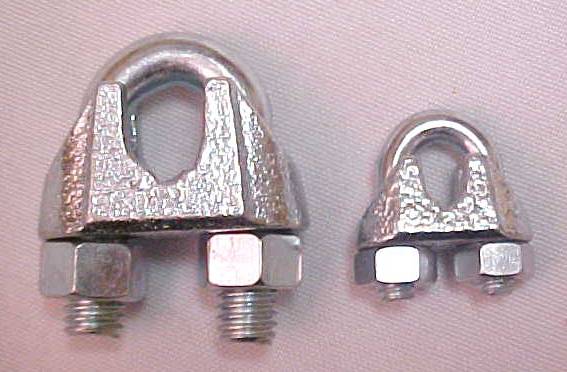
Wire Nuts Large #WNL $4.00
each for 5/16 and 3/8" wire core halyard
Wire Nuts Small #WNS $1.50
each for 1/4" wire core halyard |
 |
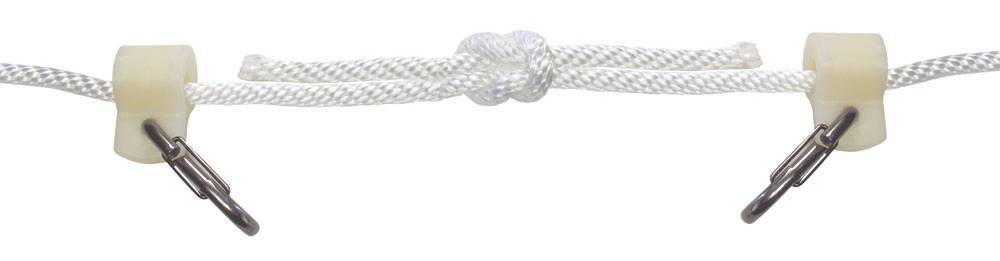
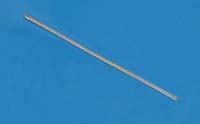
Wire core halyard is tougher to tie knots in than
regular rope. Some guys say they have no problem just knotting it. I
don't see how. Here is how I have used it to rig a flagpole. For
good measure I used two wire nuts, but I have shown only one wire
nut to make the photo more clear. Note I've melted the ends to seal
the fibers.
|
|
|
Stainless Steel Cable
| Model # |
Diameter |
Price per for for 1'-199' |
Price per for for 200' or more |
| SSC32 |
3/32" |
$2.50 |
$2.30 |
| SSC18 |
1/8" |
$2.60 |
$2.35 |
| SSC316 |
3/16" |
$2.80 |
$2.60 |
|
|
How much halyard do I need? Typically get twice the above ground length of your flagpole. If your cleat is mounted at the typical eye level, that will give you enough extra for making knots and wrapping the halyard off around the cleat. This halyard is great for a thousand and one uses around the home. So if you get a little extra, you'll find a use for it some day.
Helpful hint: If you need to cut the halyard, seal the end by melting it with a match. That will seal the fibers so they do not unravel.
|
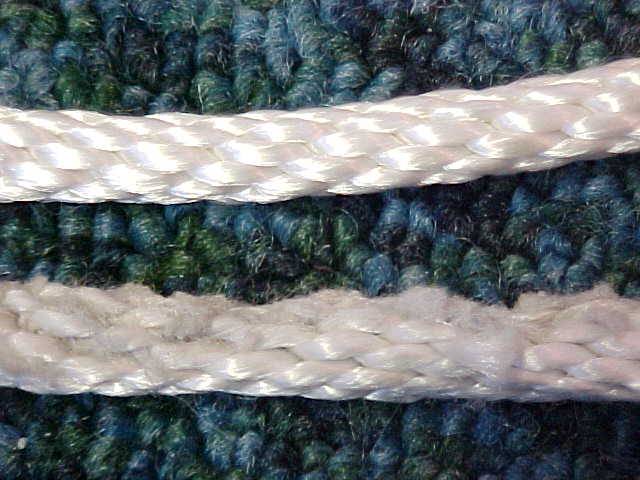
Worn rope on flagpole |
How to
spot worn out halyard
While you are at it, each time you
change your flag, INSPECT YOUR HALYARD! This task should be as automatic as
changing the batteries in your smoke detector each year when you set the clocks
back.
I can not predict how long your halyard will last. You do need to
keep an eye in it.
It you see the halyard showing signs of wear, you
are playing Russian roulette. As long as the old worn halyard is still in your
pole, you can use it to pull a new halyard up through the pulley. If you let it go
too long and it breaks.. well, call your local bucket truck guy and ask him how
much he charges per hour.
Helpful Hint: Halyard wears particularly hard where the snap
hooks are attached. Move the position of your snap hooks every so often to
extend the life of your flagpole rope.
|
Why polyester halyard and not nylon halyard?
Polyester has better resistance to abrasion than
nylon, greater strength, and better UV resistance. Both have
excellent resistance to rot and mildew. Nylon has greater stretching
capabilities. That is a preferred attribute if you are a mountain
climber, but it is not a preferred attribute for a flagpole. If you
are a climber falling on your rope you want nylon's shock-load
absorption ability. You want the rope to stretch a bit. In your
flagpole, you want the rope to stay as tight as possible. Polyester
will have less elongation than nylon. It will stretch less and stay
taut more. This attribute is particularly important the larger the
flag you have. Elongation in flagpole rope is a bummer. Elongation
in mountain climbing rope is a life saver.
|
|
Safety Warning: Rope is a tool and should be
used with the utmost caution. We sell only flagpole halyard. All the rope
on this page is for use only in a flagpole. It is flagpole rope. We sell no rope intended for use in
applications such as tree work or as personal safety lines where danger to life,
limb or property exists. The flag rope on this page is not to be used to raise loads
or persons. It is not to be used as safety lines. It is not to be used where
life, limb or personal safety are involved.
Never stand in line with a rope or cord under load. Rope has
built in elasticity and a snap back can occur if there is a break. Estimated
break strengths are for new and unused rope. A knot can reduce rope strength by
over 50%. Store rope out of sunlight to prevent degrading.
Working loads are for rope in good condition with appropriate
splices and under normal service conditions. Working loads are not applicable
when rope is subject to shock or dynamic loading. These can cause failure to a
rope that is normally strong enough to handle the job.
The url for this page is http://flagguys.com/halyard.html
1 12 23 |
 Other Flagpole Parts