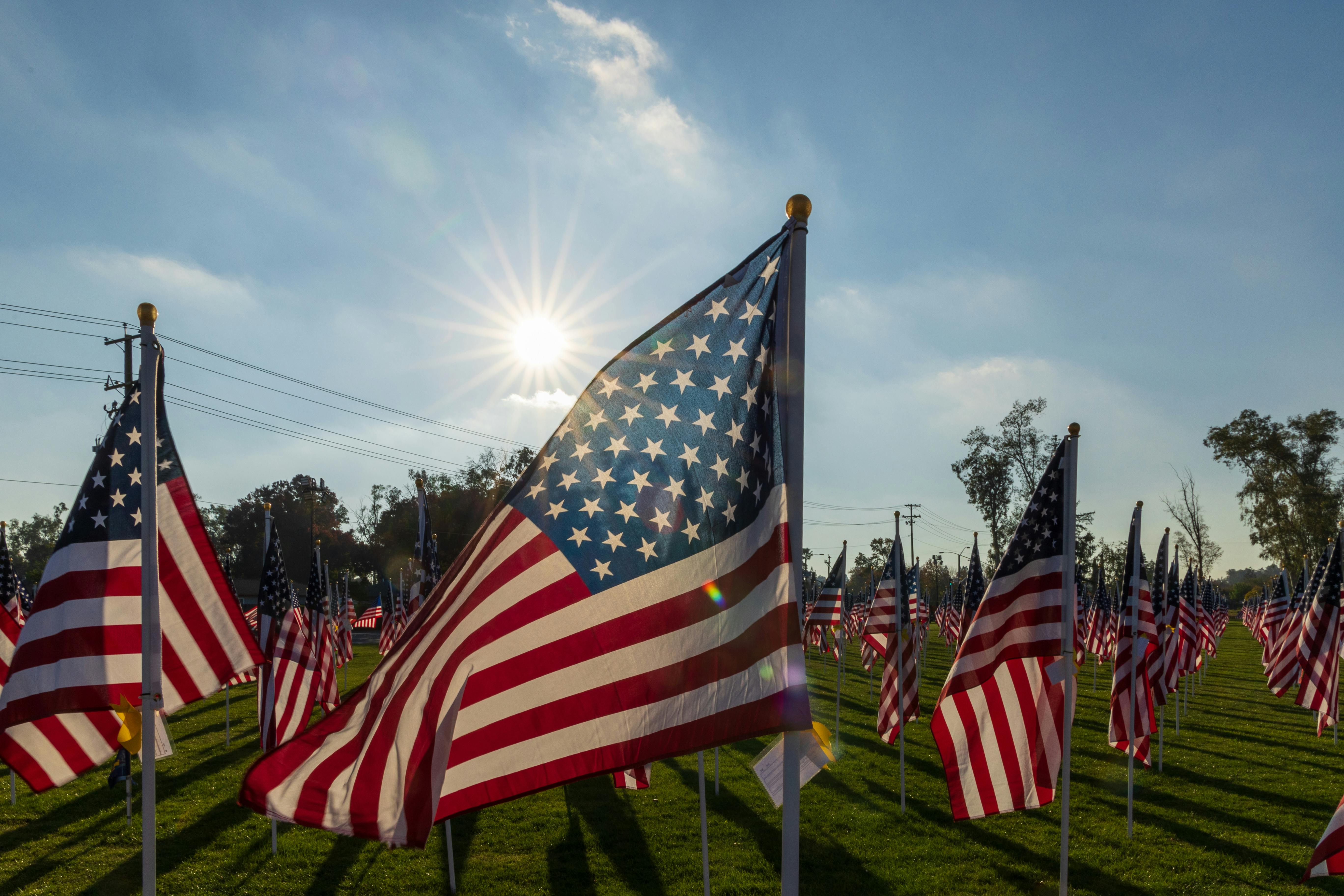
What's the difference between nylon and polyester flags?
Nylon is lighter and flies in a gentle breeze — the standard choice for most residential flagpoles. Two-ply polyester is heavier and significantly more durable, built for coastal areas, high-wind locations, and commercial flagpoles that fly 24/7. Cotton is for indoor display only.
Material
Weight
UV Resistance
Wind Range
Outdoor Lifespan
Best For
200-denier Nylon
Lightweight
High
Light to moderate
6–12 months residential
Residential, inland, moderate wind
2-ply 100% polyester bunting
Heavy
High
Moderate to severe
1–2+ years coastal/commercial
Coastal, high-wind, commercial
Cotton
Heavy
Low
N/A — indoor only
Not suited for outdoors
Indoor display, parades, presentation
The 200-denier nylon flag is the residential standard. It dries fast after rain, holds dye well, and flies actively in a light breeze. Its limitation is wind load — in sustained high winds or coastal salt air, nylon eventually shreds at the fly end. If you're replacing a nylon flag every six months, you likely need polyester.
Two-ply polyester is a fundamentally different product. The 600-denier two-ply construction means two layers of thick polyester woven together — heavy, stiff, and built for punishment. It needs more wind to fly, but in consistently windy or coastal conditions it outlasts nylon by a wide margin. Commercial and institutional poles almost always use polyester.
Cotton is the traditional material for formal indoor use — it drapes beautifully and has a richness synthetic materials can't match. Outdoors, it degrades quickly: poor UV resistance, absorbs water, and breaks down under sun and wind. We don't sell cotton flags for outdoor use.
What is the most popular flag material for residential use?
200-denier nylon is by far the most common choice for residential outdoor flagpoles. It's lightweight, flies in a gentle breeze, resists UV fading well, and dries fast after rain. Most of the U.S. flags we sell to homeowners are 200-denier nylon.
What is two-ply polyester, and when should I buy it?
Two-ply polyester — sometimes called 'iron man' or 'heavy-duty' — is made from two layers of 300-denier polyester woven together. It's significantly heavier and more wind-resistant than nylon. Buy it for coastal areas, high-wind installations, and commercial flagpoles flying flags continuously. If you're replacing your third nylon flag in a year, you need two-ply polyester.
Can I fly a cotton flag outdoors?
Technically yes, but it will deteriorate quickly. Cotton flags are designed for indoor display, parades, and formal presentations — not continuous outdoor exposure. Rain, UV, and wind will degrade a cotton flag in weeks to months outdoors. If you need outdoor durability, use nylon or polyester.
How long does a nylon flag last outdoors?
Under normal residential conditions — flown from sunrise to sunset, brought in during severe weather, moderate wind and UV exposure — a quality 200-denier nylon flag typically lasts 6 to 12 months. Heavy commercial use, coastal salt air, or high-UV southern locations will shorten that. Polyester runs 1–2+ years in similar conditions.
What does 'denier' mean for flags?
Denier is a measure of fiber thickness — specifically, the weight in grams of 9,000 meters of a single fiber. Higher denier means thicker, heavier fabric. 200-denier nylon is the residential standard. 600-denier two-ply polyester is commercial-grade. The denier rating appears in most flag product descriptions.
Does the flag material affect how it flies?
Yes, significantly. Nylon is lightweight and flies well even in a light breeze — it responds quickly and ripples gracefully. Two-ply polyester is heavier and needs more wind to fly fully. On a calm day, a polyester flag may hang limp while a nylon flag is active. In a stiff wind, both fly well, but polyester handles the load better.
Flag Sizing
What size flag do I need for my flagpole?
The rule of thumb: your flag's fly length should be approximately one-quarter the height of the flagpole. A 20-foot pole takes a 3×5 or 4×6 flag; a 25-foot pole takes a 4×6 or 5×8; a 30-foot pole takes a 5×8 or 6×10. Oversizing stresses grommets and halyard hardware.
Pole height
Recommended flag size(s)
15 ft
2½×4 or 3×5
20 ft
3×5 or 4×6
25 ft
4×6 or 5×8
30 ft
5×8 or 6×10
35 ft
6×10 or 8×12
40 ft
8×12
50 ft
10×15
60 ft
10×15 or 12×18
70 ft+
12×18 or 15×25
An undersized flag looks thin and lost on a tall pole. A properly sized flag fills the sky with visual weight and presence — this matters most when visible from the street. Oversizing creates the opposite problem: a flag that's too large for its pole acts like a sail, stressing the snap hooks, grommets, and halyard. In a 30-mph wind, a seriously oversized flag can shear snap hooks and flex the pole.
Not sure what size to order? Call us at (845) 562-0088 — we'll match the right flag to your pole in about three minutes.
What size flag do I need for a 20-foot flagpole?
A 3×5 is the minimum; a 4×6 is the better choice for a 20-foot pole. The 4×6 fills the sky more proportionately and doesn't look undersized from the street. Both sizes work with standard residential snap hooks.
What size flag for a 25-foot residential flagpole?
A 4×6 is the standard choice for a 25-foot residential pole. If you want a larger visual presence, a 5×8 works well on a 25-foot pole — it's more visible from the street and looks more proportionate on a taller pole.
Can I use a 5×8 flag on a 20-foot pole?
We strongly advise against it. A 5×8 flag is too large for a 20-foot pole. In the wind, it puts extra force on the pole and can cause damage. For a 20-foot pole, choose a 3×5 or 4×6 flag instead.
Do commercial flagpoles need a different flag size?
Yes. Commercial poles (30 feet and up) are designed for heavier hardware and larger flags. A 30-foot commercial pole typically flies a 5×8 or 6×10 flag. Schools and municipal buildings with 40–50-foot poles generally use 8×12 or 10×15 flags. Call us at (845) 562-0088 with your pole height and we'll match the right size.
What about telescoping flagpoles — do they need a different flag size?
Match the flag size to your actual flying height, not the pole's maximum extension rating. A pole rated to 25 feet that you typically extend to 18–20 feet should fly a 3×5, not a 4×6. Most residential telescoping poles are designed for 3×5 flags. Check the product specs for the maximum recommended flag size.
Flag Care & Display
How do I make my U.S. flag last longer?
Take the flag down during severe storms, high winds, heavy snow, and icing. Keep it away from surfaces it could rub against — buildings, gutters, trees. Inspect it monthly for fraying and loose stitching. Hand-wash with mild soap and lukewarm water, air dry completely before flying or storing. Never store a wet flag.
Should I take my flag down during a storm?
Yes. Taking it down before severe weather is the best way to protect the flag and reduce stress on the flagpole and hardware. Two-ply polyester is more durable in regular windy conditions, but no outdoor flag is storm-proof. If severe weather is expected, lower the flag before conditions become unsafe.
Can I fly my U.S. flag during the winter?
Yes, but winter conditions are hard on flags. Strong winds, wet snow, freezing rain, and ice add weight and stress to both flag and pole. Take the flag down during winter storms, and make sure it is completely dry before storing it.
Can I fly my U.S. flag at night?
Yes. The U.S. Flag Code permits 24-hour display when the flag is properly illuminated during hours of darkness. The light must reach the flag itself — not just the base or shaft of the pole. If the flag cannot be adequately illuminated, lower it at sunset.
When should I replace my American flag?
Replace the flag when you see excessive fraying, large tears, significant fading, loose stitching, worn corners, or damage around the heading and grommets. Fabric that feels thin or brittle is nearing the end of its life. When an American flag is no longer fit for display, retire it respectfully — many American Legion and VFW posts hold retirement ceremonies.
Why does my flag fade so quickly?
All outdoor flags fade eventually — sun, wind, rain, and everyday use take a toll. Lower-priced flags use lighter fabric and less durable dyes that break down faster. On a quality flag, colors are applied using processes designed for outdoor exposure. Red areas typically show fading first. The best protection: choose a quality flag for your conditions, keep it away from surfaces it can rub against, and bring it down during severe weather.
Are your U.S. flags made in the USA?
Every U.S. flag we sell is proudly made in the United States by trusted American manufacturers — Eder Flag, Annin & Co., and Valley Forge. We've been committed to American-made U.S. flags since 1977, and that's not changing.
How should I display the U.S. flag with a state or other flag?
The U.S. flag always gets the position of honor — its own right (the observer's left). Both flags should fly at equal height, with the U.S. flag in the dominant position. The same principle applies when flying with a military or organizational flag. If you're unsure about a specific setup, give us a call.
Flagpoles & Hardware
Do I need to illuminate my flag if I fly it at night?
Yes. The U.S. Flag Code states that the American flag may be displayed 24 hours a day when it is properly illuminated during the hours of darkness. The light should reach the flag itself — not just the base or shaft of the pole. If the flag cannot be adequately illuminated, it should be lowered at sunset.
What's the difference between solar and wired flagpole lighting?
Solar lights are convenient — no wiring, automatic dusk-to-dawn operation, easier installation. They work well for residential poles with good direct sunlight. Wired lighting provides stronger, more consistent output and is often the better choice for taller poles, larger flags, commercial properties, schools, and locations with limited sun. Tell us your pole height, flag size, and whether electricity is available — we'll narrow it down.
Can I install flagpole lighting myself?
Many solar lights are designed for straightforward homeowner installation. Wired fixtures can be more complicated and may require a licensed electrician. If you're unsure about the installation or local electrical requirements, professional installation is the safer choice.
How often should I inspect my flagpole lighting?
Check the system at least once a month and after severe weather. Make sure the light is on, the fixture hasn't shifted, and the lens or solar panel is clean. Dirt, pollen, leaves, snow, and debris reduce output or prevent a solar panel from charging. Replace burned-out bulbs, weak batteries, or damaged components promptly.
What should I consider when choosing a flagpole for a high-wind location?
Consider the pole's height, diameter, wall thickness, material (aluminum vs. fiberglass), wind ratings (flagged and unflagged), flag size, and number of flags you plan to fly. Two poles of the same height can have very different structural capabilities. The foundation and installation matter as much as the pole itself. Professional installation is strongly recommended for larger poles and high-wind sites.
Can I fly two flags on the same pole?
Yes, but flying two flags increases wind load on both the pole and hardware. The U.S. flag must always fly at the top. The second flag is often one size smaller than the main flag. Confirm that the pole, truck, snap hooks, and halyard are rated for the combined size and weight. In consistently windy locations, a separate pole for the second flag may be the better call.
How do I know when to replace a snap hook or halyard?
Inspect snap hooks, halyards, and hardware at the same time you inspect your flag — at least monthly and after any significant weather event. Look for corrosion, cracking, fraying, or worn attachment points. A failing snap hook can drop your flag; a frayed halyard can snap under load. Replace worn hardware promptly to protect both the flag and the pole.
What's the difference between an internal and external halyard flagpole?
An external halyard pole uses a rope on the outside of the pole tied off to a cleat — simpler, less expensive, but accessible to anyone who can reach it. An internal halyard pole routes the rope through the inside of the pole and locks at the base, making it far more secure. Internal halyard poles are the standard for government, school, and commercial installations where security matters.